Do I Need a Scale to Make Pizza Dough? (Plus Tips!)
 Pete McPherson Last updated
There are already a TON of pizza accessories you’ll wind up buying as a DIY pizza nerd.
Ovens, peels, and scales, oh my! 😎
But do you absolutely need a scale to make pizza dough?
A simple scale is really important for making pizza dough. Although you can find pizza recipes that use pre-defined measurements like cups, tablespoons, etc., you’ll likely use “baker’s percentages” to customize and adapt your dough, which requires weighing your ingredients with a scale.
Luckily, there are many high-functioning scales available that won’t put a dent in your wallet.
(At least not as much as Ooni ovens. Sheesh).
Let’s weigh in ⚖️👇
Why Are Scales Important for Pizza Making?
To make pizza, you’ll need to measure your ingredients accurately. Measuring allows you to create a consistent dough each and every time.
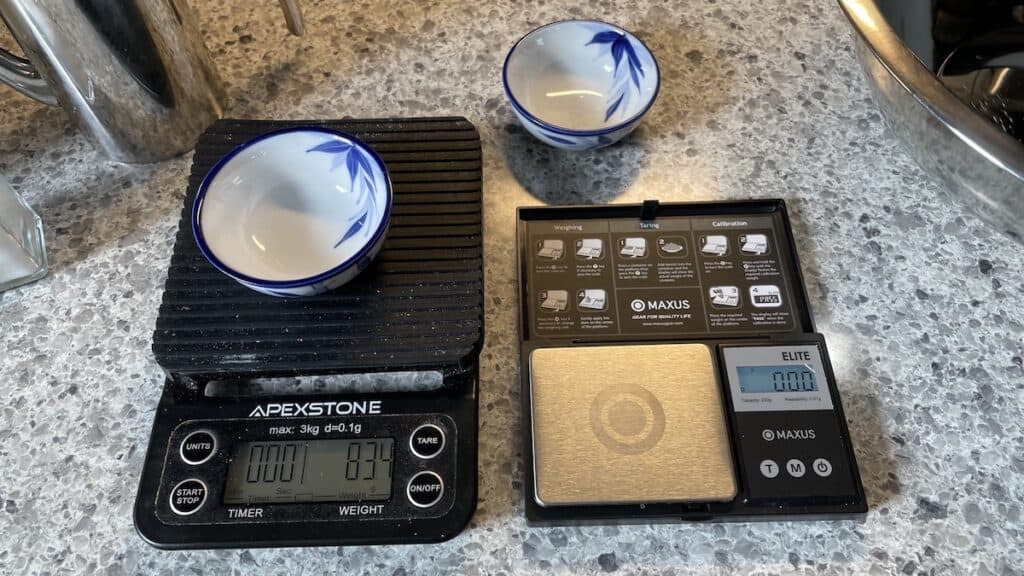 my cheap Amazon scales work great!
Many recipes allow you to use cups and teaspoons to measure ingredients, but pizza-making requires exact measurements. Most pizza makers write recipes using baker’s percentage, which relies on some really easy calculations that allow you to CUSTOMIZE how much dough you need!
PRO TIP: What’s the difference between measuring using “cups” or “tablespoons,” vs a scale?
- Measuring cups measure by volume
- Kitchen scales measure by weight (usually grams)
Imagine pouring the wrong amount of yeast into your dough recipe. You’ll impact the leavening of your dough.
Scales allow you to measure precise amounts (ex: 0.75 grams). By using a scale, you take the guesswork out of your recipes. You know your dough will rise when you add the proper amount.
Scales also allow you to customize dough recipes. Using baker’s percentage, you can increase or decrease the dough you wish to make.
Got a friend coming over this Friday and need to make 10-20% more pizza? That’s really easy using scales!
(Imagine trying to measure 10% of a “cup” of flour.)
Do you want to make twice as much or reduce the recipe by half? That’s easy to do with baker’s math.
What Is the “Baker’s Percentage?” and How Do I Use It?
Baker’s percentage is a simple mathematical method that expresses the percentage of an ingredient against the total weight of flour in a recipe.
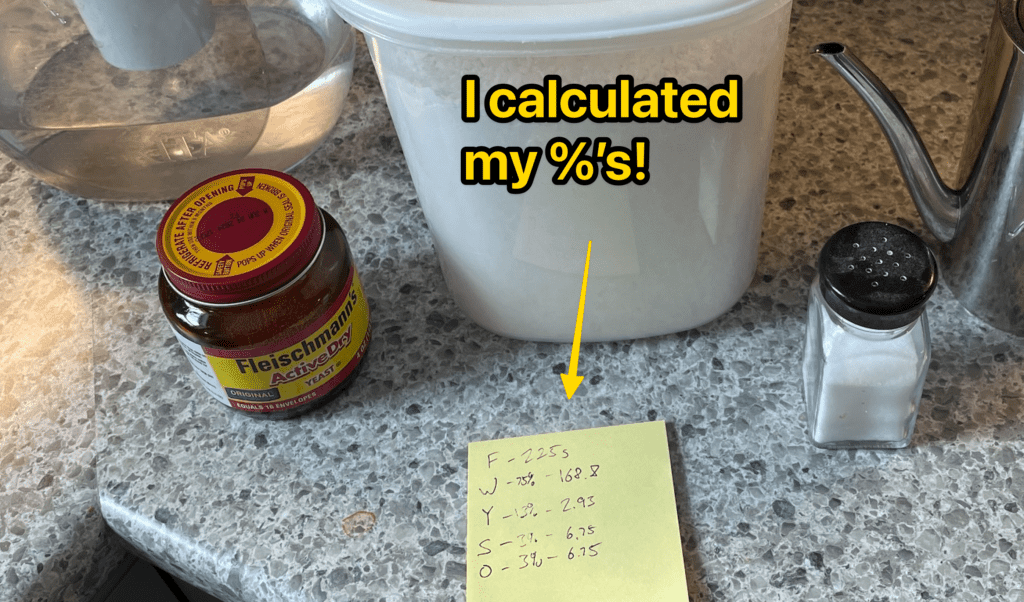
To calculate a baker’s percentage, you’ll start with flour at 100% and add other ingredients as a percentage of that amount.
Flour is the most important ingredient in pizza dough, so we measure all ingredients against it.
Here is the baker’s percentage formula:
Weight of the Flour * % of ingredient = Weight of the Ingredient
For example, if you’re starting with 500g of flour, and looking at a recipe that calls for 65% water (“65% hydration”), you’d put in 325g.
325 is 65% of 500.
How much an ingredient weighs is less important than how much it weighs in relation to other ingredients. You’ll want to use the baker’s percentage to ensure all ingredients maintain their proper percentages.
Changing the ratio of one ingredient can drastically change the taste or texture of a recipe. By keeping the proportions steady, you ensure consistent results.
(Hence why scales are pretty much mandatory for making dough).
Related post: Should I wash a pizza stone?
Here’s an example of baker’s percentages in action (I calculated the weight on the left column from the listed percentages):
Weight
Ingredient
Baker’s Percentage
465.67g
Bread Flour
100.00%
288.72g
Water
62.00%
13.97g
Salt
3.00%
2.33g
Yeast
0.5%
9.31g
Oil
2.00%
The Advantages of Using Baker’s Percentage
There are many advantages of using baker’s percentage when making pizza dough:
- You can quickly assess recipes. For example, a recipe with a high water percentage will create a wet dough. If you want a drier dough, it’s easy to compare two formulas and choose the recipe with less hydration.
- Baker’s percentage allows you to scale formulas (recipes) up and down. If you decide to make a loaf of bread for your neighbor, you can double your recipe. If your kids call to say they won’t be home for dinner, you can scale it back.
- It’s easy to share with other pizza nerds! Just send them the percentages, and they can make as much dough as they need.
- It also enables you to eliminate food waste. Let’s say you want to make four 12-inch pizzas. If each dough ball weighs 250g, you can quickly determine how much flour, water, salt, and yeast you’ll need to make the precise amount.
The Best Scales for Making Pizza Dough
To make pizza, you’ll want a kitchen scale that can measure grams in small increments. Most kitchen scales will do this, but some are more precise than others.
To use baker’s percentage, it’s handy to have a scale with accurate measurements up to 100th of a gram. For example, when measuring yeast to 0.75g, you’ll need a scale that measures that precise amount.
Rounding up to 1g might actually be too much.
The problem: scales that can measure 500g in flour AND have accuracy to a 100th of a gram are super expensive.
The solution: Get two cheap ones?
If you’re searching for scales, look for jewelry scales that can measure small sizes. This precision pocket scale is so tiny that it can fit in your pocket and is perfect for measuring yeast, salt, and other pizza ingredients. This scale will take up very little space in your kitchen, but it only measures up to 200g, so you’ll need another scale for heavier ingredients.
For larger quantities, check out this scale, which can measure from 0.1g to 3000g. High-precision sensors provide accurate measurements so your pizza dough will have the perfect mix of ingredients.
Do you NEED two scales? No, of course not! It’s just what works for me. But you DO need a scale that can measure the amount of flour you’ll be using (i.e. 400-500g+). That’s most important.
How to Use a Digital Scale
Here are the steps to use a digital scale:
- Turn the scale on.
- Set your scale to the unit of measurement you wish to use. (grams or ounces)
- Place your bowl on top of the scale. Press the tare button so the bowl’s weight is accounted for when measuring.
- Wait for the scale to display zero again. (Clicking tare removes the bowl’s weight from the scale and returns the display to zero.)
- Add your ingredient to the bowl until you reach the desired amount.
- Set that ingredient aside.
- Return to step one.
How Do You Weigh Pizza Dough?
Weighing the ingsredients for pizza dough is easy.
- Using a scales, weigh each ingredient using the weight calculated by your baker’s percentage or pizza calculator app.
- Weigh the water, salt, and yeast separately.
- Then combine them into a separate bowl.
- Weigh the flour, then combine it with the other ingredients.
- After you’ve combined all ingredients, it’s time to knead the dough.
- After the bulk proof phase split the dough and weigh the doughballs to ensure each ball weighs the same.
What Are Some Good Pizza Calculators?
Baker’s math might be confusing at first. But I have good news. If all that math seems too complicated, you can use pizza calculators to run formulas for you.
To use a pizza calculator, input information about the pizza you want, including the style, number of pizzas, size, type of yeast, and amount of water. The calculator will determine the weights of each ingredient you need to use.
My favorite calculators are:
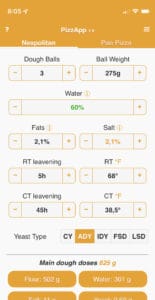
- Pizzapp (mobile app)
- Ooni (mobile app)
- Stadler (best for desktop)
Pizza Scale F.A.Q.
Is a food scale necessary for baking?
A food scale is necessary for making consistently good pizza dough. Scales allow you to measure precise ingredients and are a must-have if you plan to use baker’s percentages for your recipes.
How do you measure yeast for pizza dough?
Measure yeast using a kitchen scale that can measure ingredients to the 100th gram. For specific instructions on how to use a scale, see the details above.
Do you need a scale to make bread?
You don’t need a scale to make bread, but most bakers recommend one. With a scale you can increase or decrease the amount of bread you make and ensure consistent results every time you bake.